11 ready-made review sets for this theme, by subtopic and marked SL or HL, plus 2 mixed review sets that run into it. Free to host, and students join with a code.
Theme B links structure to function at every scale. Molecules: carbohydrates, lipids and proteins. Cells: membranes and membrane transport, organelles and compartmentalization, and cell specialization. Organisms: gas exchange and transport, with muscle and motility at higher level. Ecosystems: adaptation to environment and ecological niches.
Where students slip
Condensation joins monomers and releases water; hydrolysis uses water to split them.
Saturated fatty acids have only single bonds between their carbon atoms; unsaturated fatty acids have at least one carbon-carbon double bond.
Ventilation, gas exchange and cell respiration are three different things.
Arteries carry blood away from the heart, and it is not always oxygenated: the pulmonary artery carries deoxygenated blood to the lungs.
A niche is not just where a species lives. The fundamental niche is the full range of conditions and resources it could use; the realized niche is the part it actually uses once competitors are present.
The sets
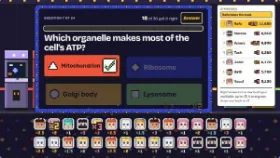
Play this set opens the set in splycr, where you can read every question and host it for your class straight away. Hosting needs no account, and students join with the code on the board. A free account lets you copy a set and edit it.
The questions come from the Biology by Bradford flashcard bank, written by an IB and AP Biology teacher. Each one plays as multiple choice, and the wrong options are other answers from the same set.
Sets marked SL suit every IB Biology student, because higher level students study the standard level content too. Sets marked HL cover the additional higher level material, and six subtopics are for higher level only: A2.1, A2.3, A3.2, B3.3, C2.1 and D2.2. Some sets are marked SL and HL, and cover both.
B1 · Molecules
B1.1 Carbohydrates and lipids
B1.1 Carbohydrates
15 questionsSL
General name for the covalent bond linking any two monosaccharides, formed by condensation?
Answer: Glycosidic bond
Structural beta-glucose polymer found in plant cell walls?
Answer: Cellulose
What type of glycosidic bond creates a branch point in a polysaccharide?
Each of these runs across several subtopics in syllabus order, from the first code in its title to the second. They suit a review at the end of a theme.
B2.2–B3.2 Organelles, Gas Exchange & Transport
20 questionsSL and HL
What is the protein that coats the cytoplasmic side of a membrane to help it curve and form a vesicle?
Answer: Clathrin
The two specialized cells that surround a stoma and control its opening?
Answer: Guard cells
Specialized cells that provide metabolic support to phloem sieve tube elements?
Form and function answers are short names (glycosidic bond, aquaporin, sarcomere), so the bomb moves quickly and everyone answers many times. Nobody is knocked out.
A streak raises the multiplier to 3× and one slip drops it to 1×. Fast answers score a little more, but a long streak counts for more, so it rewards the student who can match every structure to its function.