Total number of protons and neutrons in an atom?
Answer: Mass number
Electrons in Mg²⁺ (atomic number 12)?
Answer: 10
Scientist who explained the gold foil results with a small, dense, positive nucleus?
Answer: Rutherford
General Chemistry · Grade 10
General Chemistry review games
Ready-made review sets for Grade 10 chemistry: 16 sets and 229 questions, one topic each, to play as a class game on the projector. Free to host, and students join with a code.
A question from the sets
An ionic bond forms by…?
- Electron transferRight answer
- Electron sharing
- Proton transfer
- Neutron sharing
The 16 sets
Play this set opens the set in splycr, where you can read every question and host it for your class straight away. Hosting needs no account, and students join with the code on the board. A free account lets you copy a set and edit it.
The questions were written for the splycr library by Biology by Bradford. Each one plays as multiple choice, and the three wrong options were written for that question.
Elements in the same group have the same number of…?
Answer: Outer electrons
Group 18 (group 0) elements are unreactive because they have a…?
Answer: Full outer shell
Reactivity of the halogens down the group…?
Answer: Decreases
An ionic bond forms by…?
Answer: Electron transfer
Formula of magnesium chloride?
Answer: MgCl₂
Simple molecular substances have low boiling points because of…?
Answer: Weak intermolecular forces
State of a substance at 25 °C if it melts at −10 °C and boils at 80 °C?
Answer: Liquid
Change of state from solid straight to gas?
Answer: Sublimation
While water boils, its temperature stays constant because energy is overcoming…?
Answer: Forces between particles
Coefficient of H₂ when N₂ + H₂ → NH₃ is balanced?
Answer: 3
Number of hydrogen atoms shown by 3H₂O?
Answer: 6
Ionic equation for neutralisation?
Answer: H⁺ + OH⁻ → H₂O
Relative formula mass of CO₂ (C = 12, O = 16)?
Answer: 44
Amount in 9 g of water (Mr = 18)?
Answer: 0.5 mol
Mass of CO₂ formed when 6 g of carbon burns (C = 12, CO₂ = 44)?
Answer: 22 g
Moles of O₂ needed to burn 2 mol of CH₄ (CH₄ + 2O₂ → CO₂ + 2H₂O)?
Answer: 4 mol
Mass of water formed when 4 g of H₂ burns (2H₂ + O₂ → 2H₂O; H₂ = 2, H₂O = 18)?
Answer: 36 g
Percentage yield when 8 g of product forms but 10 g was expected?
Answer: 80%
Ion that makes a solution acidic?
Answer: H⁺
Salt formed when sulfuric acid reacts with copper(II) oxide?
Answer: Copper(II) sulfate
Effect on pH of a tenfold increase in H⁺ concentration?
Answer: Decreases by 1
Apparatus that delivers a variable, accurately measured volume of solution?
Answer: Burette
Point in a titration at which the indicator just changes colour?
Answer: End point
0.0025 mol HCl neutralises 25.0 cm³ of NaOH(aq). Concentration of the NaOH?
Answer: 0.10 mol dm⁻³
Minimum energy colliding particles need for a reaction to happen?
Answer: Activation energy
Powdered marble reacts faster than marble chips because it has a larger…?
Answer: Surface area
A gas volume–time graph levels off because…?
Answer: A reactant runs out
In an endothermic reaction, the temperature of the surroundings…?
Answer: Falls
Overall energy change if breaking bonds takes 500 kJ and making bonds gives 700 kJ?
Answer: −200 kJ
Everyday product that uses an exothermic reaction?
Answer: Hand warmer
Negative electrode?
Answer: Cathode
Product at the anode when molten PbBr₂ is electrolysed?
Answer: Bromine
Metal extracted by electrolysing its molten oxide dissolved in cryolite?
Answer: Aluminium
Element used to remove oxygen from iron oxide in a blast furnace?
Answer: Carbon
Zinc still protects scratched iron because zinc is…?
Answer: More reactive
Which of these metals will not displace copper from copper(II) sulfate solution?
Answer: Silver
Saturated hydrocarbons with only single C–C bonds?
Answer: Alkanes
Colour of orange bromine water after shaking with an alkene?
Answer: Colourless
Breaking long-chain hydrocarbons into shorter, more useful molecules?
Answer: Cracking
Liquid that passes through the filter paper?
Answer: Filtrate
Method to separate ethanol from a mixture with water?
Answer: Fractional distillation
Rf of a spot that moves 2.0 cm when the solvent moves 8.0 cm?
Answer: 0.25
Approximate percentage of nitrogen in dry air?
Answer: 78%
Greenhouse gas released by cattle and rice paddies?
Answer: Methane
Acidic gas, released by volcanoes and coal-fired power stations, that causes acid rain?
Answer: Sulfur dioxide
What the sets cover
Sixteen sets on the chemistry most courses teach around Grade 10, one topic each: atomic structure and the periodic table; bonding and states of matter; equations, the mole and stoichiometry (reacting masses, limiting reactants and yield); acids and alkalis, and titration; rates of reaction and energy changes; electrolysis, and metals and reactivity; organic chemistry, from alkanes and alkenes to crude oil and cracking; separation techniques; and the atmosphere and air pollution. Play the set for the topic you have just taught, or use them together as a review of the basics before IB or AP Chemistry.
Where students slip
- The mass number counts protons and neutrons; the atomic number counts protons alone. Subtract one from the other to find the neutrons.
- Ions form when atoms gain or lose electrons, never protons. Mg²⁺ has lost two electrons and still has 12 protons.
- When a simple molecular substance melts or boils, the weak forces between the molecules are overcome. The covalent bonds inside the molecules don't break.
- In electrolysis, positive ions move to the negative electrode, the cathode, and gain electrons there; negative ions move to the anode and lose them.
Game modes that suit these sets
Every set plays in all eight modes. These two fit these sets best.
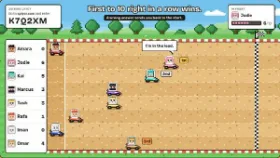
Racer solo
In solo Racer the track is as long as the set, up to 12 cards, and one wrong answer sends a student back to the start. Every General Chemistry set has 12 to 15 questions, so finishing takes twelve right answers in a row.
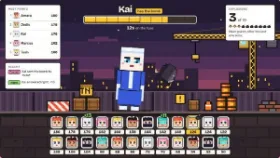
Kaboom
The answers are short (cathode, filtrate, alkali metals, 0.5 mol), so the bomb moves fast and every student answers many times. Nobody is knocked out: the holder just loses points when it goes off.
Why review with a game
Answering from memory does more for recall than rereading notes, and a game gets the whole class answering, not just the students with a hand up. Every question in these sets is short, with a one-line answer, so a set makes a quick starter, a check at the end of a topic, or a review before a test.
How a class plays
- Open a set and press Host a game. Pick one of the sets above and choose a game mode. You don't need an account to host.
- Put the room code on the projector. It comes with a QR code that opens the game on a phone.
- Students join with the code and their first name. They go to splycr.com on a phone, tablet or laptop. No student accounts, nothing to install.
A free account lets you copy a set to edit it, write your own, and set it as homework.
Eight ways to play the same set
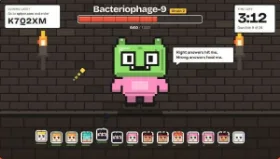 Boss BattleThe whole class fights one boss. Right answers hit it, wrong ones heal it.
- RacerEach right answer moves you forward. Play solo or in teams.
- KaboomAnswer right to pass the bomb on. Hold it when it goes off and your points go to everyone else.
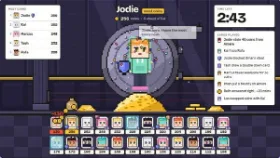 SabotageRight answers earn coins and cards that freeze, steal, swap or shield.
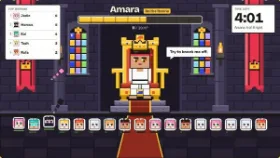 ThroneOne student holds the throne and the rest of the class tries to take it.
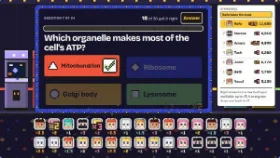 SplycrQuick-fire questions. A streak stacks your multiplier up to three times.
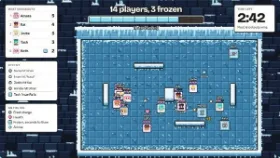 CryoA frozen arena of frost charges. Answer a question to reload.
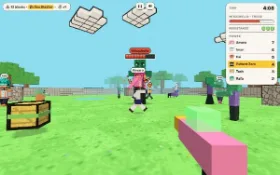 OutbreakA first-person zombie arena for laptops. Answer right to get back in.
Questions teachers ask
Do students need an account?
No. Students join with the code on the board and their first name, from any browser. There is nothing to install.
Is it free?
Hosting a game is free, with or without an account, and so is an account. Only generating new questions with the question generator uses credits; these sets are already written.
Which course do the sets follow?
No single exam board's. They cover the chemistry most courses teach around Grade 10, from atomic structure to the atmosphere, so they suit GCSE, IGCSE and MYP classes, or a review of the basics at the start of IB or AP Chemistry. Each set is one topic, named plainly.
What kind of questions are they?
Short questions with a one-line answer: a word, a formula, a colour change or a quick calculation, such as the neutrons in sodium-23 or the moles in 9 g of water. They are for retrieval practice and vocabulary review.
Where do the questions come from?
They were written for the splycr library by Biology by Bradford. Each question plays as multiple choice, with three wrong options written for that question.
Can I change the questions?
Yes. A free account lets you copy any set and edit it, or write a set of your own.
Teaching IB Chemistry, or biology or ESS too? The library has sets for these courses as well.