IB Chemistry review games
Ready-made review sets for all six topics of the IB Chemistry syllabus: 32 sets and 460 questions by subtopic, marked SL or HL, to play as a class game on the projector. Free to host, and students join with a code.
Molecular geometry of NH₃?
- Trigonal planar
- Tetrahedral
- Trigonal pyramidalRight answer
- Bent
The six topics
Sets marked SL suit every IB Chemistry student, because higher level students study the standard level content too. Sets marked HL cover the additional higher level material: ten subtopics have an HL set after their SL one, and R1.4 Entropy and spontaneity, which is for higher level only, has an HL set of its own.
- Structure 1: Models of the particulate nature of matterParticles, atoms, electron configurations, the mole and gases.6 sets · 86 questions
- Structure 2: Models of bonding and structureIonic, covalent and metallic bonding, and the materials they make.5 sets · 70 questions
- Structure 3: Classification of matterThe periodic table, its trends, and functional groups.4 sets · 59 questions
- Reactivity 1: What drives chemical reactions?Enthalpy changes, energy cycles, fuels and entropy.5 sets · 69 questions
- Reactivity 2: How much, how fast and how far?Amounts and yield, rates of reaction and equilibrium.5 sets · 72 questions
- Reactivity 3: What are the mechanisms of chemical change?Acids and bases, redox, radicals and organic mechanisms.7 sets · 104 questions
Why review with a game
Answering from memory does more for recall than rereading notes, and a game gets the whole class answering, not just the students with a hand up. Every question in these sets has a one-line answer: a term, a formula, a shape or a short calculation with round numbers. Each set follows one subtopic of the guide, named by its code, so you can play the set for the subtopic you have just taught, or the SL and HL sets of a topic before a test.
How a class plays
- Open a set and press Host a game. Pick it from a topic above and choose a game mode. You don't need an account to host.
- Put the room code on the projector. It comes with a QR code that opens the game on a phone.
- Students join with the code and their first name. They go to splycr.com on a phone, tablet or laptop. No student accounts, nothing to install.
A free account lets you copy a set to edit it, write your own, and set it as homework.
Eight ways to play the same set
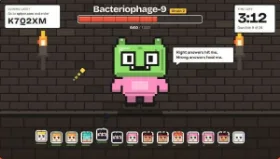 Boss BattleThe whole class fights one boss. Right answers hit it, wrong ones heal it.
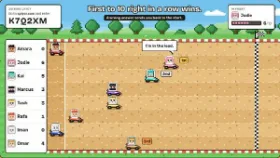 RacerEach right answer moves you forward. Play solo or in teams.
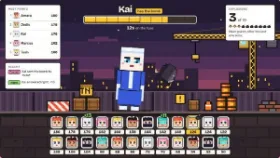 KaboomAnswer right to pass the bomb on. Hold it when it goes off and your points go to everyone else.
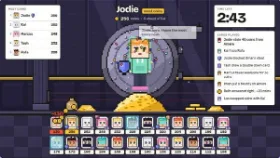 SabotageRight answers earn coins and cards that freeze, steal, swap or shield.
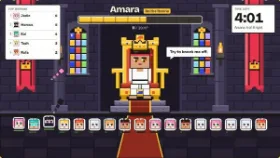 ThroneOne student holds the throne and the rest of the class tries to take it.
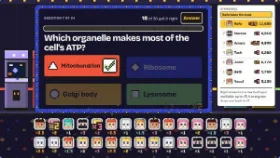 SplycrQuick-fire questions. A streak stacks your multiplier up to three times.
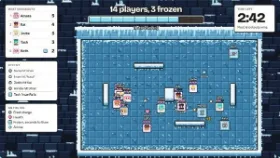 CryoA frozen arena of frost charges. Answer a question to reload.
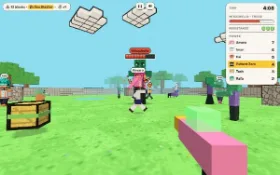 OutbreakA first-person zombie arena for laptops. Answer right to get back in.
Questions teachers ask
Do students need an account?
No. Students join with the code on the board and their first name, from any browser. There is nothing to install.
Is it free?
Hosting a game is free, with or without an account, and so is an account. Only generating new questions with the question generator uses credits; these sets are already written.
Which syllabus do the sets follow?
The IB Chemistry guide first assessed in 2025, organised around Structure and Reactivity in six topics, from Structure 1 to Reactivity 3. Each set covers one subtopic and is named by its code, such as S1.4 or R2.3.
What kind of questions are they?
Short questions with a one-line answer: a definition, a name, a formula or a quick calculation, such as the electrons in ³²S²⁻ or the pH of 0.010 mol dm⁻³ HCl. They are for retrieval practice in class, not exam-style data-based or extended-response practice.
Are the sets SL or HL?
Each set is marked SL or HL. SL sets suit every student, since higher level students study the standard level content too. Ten subtopics also have an HL set for their additional higher level material, and R1.4 Entropy and spontaneity, which is higher level only, has an HL set alone.
Where do the questions come from?
They were written for the splycr library by Biology by Bradford, subtopic by subtopic against the IB Chemistry guide. Each question plays as multiple choice, with three wrong options written for that question, many of them the answer a common slip gives, such as 22.4 dm³ mol⁻¹ for the molar volume of a gas at STP.
Is this an official IB resource?
No. The sets follow the structure of the IB Chemistry guide, but splycr is not affiliated with or endorsed by the International Baccalaureate.
Teaching younger classes, or biology or ESS too? The library has sets for these courses as well.