3 mol H₂ and 2 mol N₂ react (N₂ + 3H₂ → 2NH₃). Which runs out first?
Answer: Hydrogen
Percentage yield when 15 g is obtained and 20 g was expected?
Answer: 75%
Volume of 0.10 mol dm⁻³ H₂SO₄ to neutralise 25.0 cm³ of 0.10 mol dm⁻³ NaOH?
Answer: 12.5 cm³
IB Chemistry · Reactivity 2
IB Chemistry Reactivity 2: How much, how fast and how far?
5 ready-made review sets for this topic, by subtopic and marked SL or HL, 72 questions in all, to play as a class game on the projector. Free to host, and students join with a code.
A question from the sets
3 mol H₂ and 2 mol N₂ react (N₂ + 3H₂ → 2NH₃). Which runs out first?
- HydrogenRight answer
- Nitrogen
- Ammonia
- Neither
What Reactivity 2 covers
Reactivity 2 asks three questions about a reaction. How much? R2.1 is stoichiometry: balanced equations and mole ratios, limiting and excess reactants, theoretical and percentage yield, atom economy, and reacting volumes of gases and solutions. How fast? R2.2 is collision theory, the Maxwell–Boltzmann distribution, the factors that change the rate and how a catalyst works; at higher level, rate equations and orders of reaction, the rate constant, reaction mechanisms and the rate-determining step, and the Arrhenius equation. How far? R2.3 is dynamic equilibrium, the equilibrium constant and Le Chatelier's principle; at higher level, the reaction quotient, equilibrium calculations, and the link between ΔG⦵ and K.
Where students slip
- The limiting reactant is not always the one with fewer moles. Divide each amount by its coefficient in the equation first: 3 mol of H₂ runs out before 2 mol of N₂.
- A rise in temperature speeds up a reaction mainly because a larger fraction of collisions have at least the activation energy, not just because the particles collide more often.
- A catalyst gets a system to equilibrium sooner but doesn't move the position of equilibrium. Only a change of temperature changes the value of K.
The sets
Play this set opens the set in splycr, where you can read every question and host it for your class straight away. Hosting needs no account, and students join with the code on the board. A free account lets you copy a set and edit it.
The questions were written for the splycr library by Biology by Bradford. Each one plays as multiple choice, and the three wrong options were written for that question.
Sets marked SL suit every IB Chemistry student, because higher level students study the standard level content too. Sets marked HL cover the additional higher level material: ten subtopics have an HL set after their SL one, and R1.4 Entropy and spontaneity, which is for higher level only, has an HL set of its own.
R2.1 How much? The amount of chemical change
R2.2 How fast? The rate of chemical change
Colliding particles react only with sufficient energy and the correct…?
Answer: Orientation
Raising the temperature makes the Maxwell–Boltzmann peak…?
Answer: Lower and shift right
A catalyst speeds up a reaction by providing a pathway with lower…?
Answer: Activation energy
Doubling [A] quadruples the rate. Order with respect to A?
Answer: 2
First-order reaction with a 10 s half-life: fraction of reactant left after 30 s?
Answer: 1/8
Gradient of an Arrhenius plot of ln k against 1/T?
Answer: −Eₐ/R
R2.3 How far? The extent of chemical change
Equilibrium can only be established in a…?
Answer: Closed system
Shift in position when pressure is increased for N₂ + 3H₂ ⇌ 2NH₃?
Answer: To the right
For an exothermic forward reaction, raising the temperature makes K…?
Answer: Decrease
If Q < K, the reaction proceeds…?
Answer: To the right
Kc for H₂ + I₂ ⇌ 2HI with [H₂] = [I₂] = 0.10 and [HI] = 0.80 mol dm⁻³?
Answer: 64
Equation linking ΔG⦵ to the equilibrium constant?
Answer: ΔG⦵ = −RT ln K
Game modes that suit this topic
Every set plays in all eight modes. These two fit this topic best.
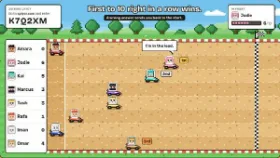
Racer solo
In solo Racer the track is as long as the set, up to 12 cards, and one wrong answer sends a student back to the start. Every Reactivity 2 set has 13 to 15 questions, so finishing takes twelve right answers in a row.
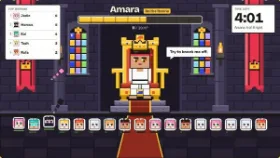
Throne
Le Chatelier questions reward the student who can reason, not just recall: which way the equilibrium shifts, and what happens to K. Put a volunteer on the throne and let the class try to take it; a wrong answer from the champion costs double.