During an endothermic reaction in solution, the temperature of the solution…?
Answer: Decreases
Equation for the heat absorbed by water in calorimetry?
Answer: q = mcΔT
ΔH when 0.10 mol of reactant releases 5.0 kJ of heat?
Answer: −50 kJ mol⁻¹
IB Chemistry · Reactivity 1
IB Chemistry Reactivity 1: What drives chemical reactions?
5 ready-made review sets for this topic, by subtopic and marked SL or HL, 69 questions in all, to play as a class game on the projector. Free to host, and students join with a code.
A question from the sets
During an endothermic reaction in solution, the temperature of the solution…?
- Increases
- DecreasesRight answer
- Stays constant
- Fluctuates
What Reactivity 1 covers
Reactivity 1 is the energy of reactions. R1.1 is measuring enthalpy changes: exothermic and endothermic reactions, energy profiles, standard conditions, and calorimetry with q = mcΔT. R1.2 is energy cycles: bond enthalpies and Hess's law, and at higher level standard enthalpy changes of formation and combustion, and Born–Haber cycles. R1.3 is energy from fuels: complete and incomplete combustion, fossil fuels and biofuels, specific energy and energy density, and fuel cells. R1.4, entropy and spontaneity, is for higher level only: entropy, the Gibbs energy change, and how temperature decides whether a reaction is spontaneous.
Where students slip
- In q = mcΔT, m is the mass of the water or solution that changes temperature, not the mass of the solid that reacted.
- Breaking bonds always absorbs energy and making bonds always releases it. From bond enthalpies, ΔH is the sum for the bonds broken minus the sum for the bonds formed, and it is only approximate, because bond enthalpies are averages.
- HL In ΔG = ΔH − TΔS, ΔH is usually in kJ mol⁻¹ and ΔS in J K⁻¹ mol⁻¹. Convert one of them before combining the two.
The sets
Play this set opens the set in splycr, where you can read every question and host it for your class straight away. Hosting needs no account, and students join with the code on the board. A free account lets you copy a set and edit it.
The questions were written for the splycr library by Biology by Bradford. Each one plays as multiple choice, and the three wrong options were written for that question.
Sets marked SL suit every IB Chemistry student, because higher level students study the standard level content too. Sets marked HL cover the additional higher level material: ten subtopics have an HL set after their SL one, and R1.4 Entropy and spontaneity, which is for higher level only, has an HL set of its own.
R1.1 Measuring enthalpy changes
R1.2 Energy cycles in reactions
Energy to break one mole of a given bond in gaseous molecules, from many compounds?
Answer: Average bond enthalpy
Bond enthalpies H–H 436, Cl–Cl 242, H–Cl 431 kJ mol⁻¹: ΔH for H₂ + Cl₂ → 2HCl?
Answer: −184 kJ mol⁻¹
Total enthalpy change is independent of the route taken: this is…?
Answer: Hess's law
ΔHf⦵ of O₂(g)?
Answer: 0 kJ mol⁻¹
Sign of lattice enthalpy as the IB defines it?
Answer: Positive
The second electron affinity of oxygen, O⁻(g) + e⁻ → O²⁻(g), is…?
Answer: Endothermic
R1.3 Energy from fuels
Toxic gas formed by incomplete combustion?
Answer: Carbon monoxide
Energy released per unit mass of a fuel, in kJ g⁻¹?
Answer: Specific energy
Burning a biofuel is close to carbon-neutral because its CO₂ was absorbed during…?
Answer: Photosynthesis
R1.4 Entropy and spontaneityHL only
State of a substance with the highest entropy?
Answer: Gas
Sign of ΔG for a spontaneous reaction?
Answer: Negative
A reaction with ΔH > 0 and ΔS > 0 becomes spontaneous…?
Answer: At high temperature
Game modes that suit this topic
Every set plays in all eight modes. These two fit this topic best.
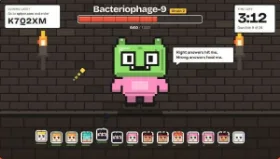
Boss Battle
Reactivity 1 is full of signs: exothermic or endothermic, ΔH positive or negative, bonds broken minus bonds formed. A wrong answer heals the boss, so a class that flips a sign loses ground.
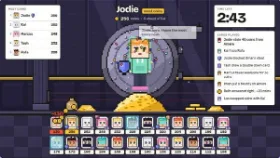
Sabotage
Sabotage runs to a clock you set (3, 5 or 8 minutes), not through the deck, so students keep answering until time is up. Power cards (freeze, steal, swap, shield) keep a student who is behind in the game.