Boundary type where plates slide past each other, such as the San Andreas Fault?
Answer: Conservative
Steep cone of alternating ash and viscous lava layers, typical of subduction zones?
Answer: Composite volcano
Weak, ductile layer of the upper mantle on which tectonic plates move?
Answer: Asthenosphere
IB Geography · Option · SL and HL
IB Geography Option D: Geophysical hazards
2 ready-made review sets for this option, 29 questions in all, for SL and HL, to play as a class game on the projector. Free to host, and students join with a code.
A question from the sets
Boundary type where plates slide past each other, such as the San Andreas Fault?
- ConservativeRight answer
- Divergent
- Convergent
- Constructive
What Option D covers
Option D starts with geophysical systems: plate tectonics, from divergent, convergent and conservative boundaries to subduction, hotspots and the forces that move plates, such as slab pull; shield and composite volcanoes; earthquakes, with their focus and epicentre; and mass movement, such as rotational slides. Geophysical hazard risks: the hazards themselves, from pyroclastic flows and lahars to liquefaction and tsunamis, and how they are measured, with the moment magnitude scale, the Modified Mercalli scale and the Volcanic Explosivity Index. Hazard risk and vulnerability: why a hazard becomes a disaster, why risk depends on vulnerability and capacity as well as on the hazard, and how people perceive it. Future resilience and adaptation: hazard mapping and land-use zoning, retrofitting, and recovery after a disaster, with the Park model.
Where students slip
- Magnitude and intensity are different scales. The moment magnitude scale measures the energy an earthquake releases, so each earthquake has one value, and each whole number up is about 32 times more energy. The Modified Mercalli scale, from I to XII, measures the effects observed at a place, so one earthquake has many values.
- A pyroclastic flow is an avalanche of hot gas, ash and rock racing down a volcano during an eruption. A lahar is a mudflow of volcanic ash and water, and it can strike far down a valley, long after the eruption, when heavy rain or melting ice remobilises the ash.
- A hazard is not a disaster in itself. It becomes one when its impacts exceed a community's ability to cope with its own resources, which is why risk is the hazard multiplied by vulnerability and divided by capacity.
The sets
Play this set opens the set in splycr, where you can read every question and host it for your class straight away. Hosting needs no account, and students join with the code on the board. A free account lets you copy a set and edit it.
The questions were written for the splycr library by Biology by Bradford. Each one plays as multiple choice, and the three wrong options were written for that question.
Ranking from I to XII of an earthquake's observed effects on people and buildings?
Answer: Modified Mercalli scale
Risk = hazard × vulnerability, divided by…?
Answer: Capacity
Effects such as fires, landslides and tsunamis that follow an earthquake's ground shaking?
Answer: Secondary hazards
Game modes that suit this unit or option
Every set plays in all eight modes. These two fit this unit or option best.
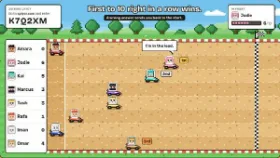
Racer in teams
Option D turns on scales that are easy to swap: moment magnitude, Modified Mercalli and the Volcanic Explosivity Index, or the focus and the epicentre. In team Racer only one teammate sees the right option, so students have to say out loud what each scale measures before anyone taps.

Boss Battle
Pyroclastic flow or lahar, hazard or disaster, retrofitting or land-use zoning: a wrong answer heals the boss, which makes the classic swaps in this option cost something, and streaks of right answers hit harder.