Incoming short-wave energy from the Sun reaching the Earth?
Answer: Insolation
Change that counteracts a disturbance, returning a system towards equilibrium?
Answer: Negative feedback
Store such as an ocean or forest that absorbs more CO₂ than it releases?
Answer: Carbon sink
IB Geography · SL and HL core
IB Geography Unit 2: Global climate—vulnerability and resilience
2 ready-made review sets for this unit, 28 questions in all, for SL and HL, to play as a class game on the projector. Free to host, and students join with a code.
A question from the sets
Incoming short-wave energy from the Sun reaching the Earth?
- Albedo
- Terrestrial radiation
- Latent heat
- InsolationRight answer
What Unit 2 covers
Unit 2 is the second core unit. The causes of global climate change: the Earth's energy balance, with insolation, terrestrial radiation and albedo; the natural greenhouse effect and the enhanced greenhouse effect; the sources of greenhouse gases, from fossil fuels to the methane from flooded rice fields; natural changes such as the cooling after large volcanic eruptions; and the feedback loops and tipping points, such as thawing permafrost, that can speed change up. The consequences of global climate change: sea-level rise and ocean acidification, the impacts on people and places, and why some communities are more vulnerable than others. Responding to global climate change: mitigation and adaptation, carbon capture and storage, cap and trade and carbon offsetting, geo-engineering, the IPCC, and agreements from the Kyoto Protocol to the Paris Agreement.
Where students slip
- Water vapour, not CO₂, makes the largest contribution to the natural greenhouse effect. The enhanced greenhouse effect is driven by the CO₂, methane and other gases human activity adds; water vapour rises as a feedback, because warmer air holds more of it.
- Melting sea ice barely raises sea level, because floating ice already displaces its own weight of water. Sea level rises through the thermal expansion of warming seawater and the melting of land ice: glaciers and the Greenland and Antarctic ice sheets.
- Mitigation tackles the cause, by cutting greenhouse gas emissions or enhancing carbon sinks; adaptation adjusts to the effects. Carbon capture and storage is mitigation; a sea wall or a drought-resistant crop is adaptation.
The sets
Play this set opens the set in splycr, where you can read every question and host it for your class straight away. Hosting needs no account, and students join with the code on the board. A free account lets you copy a set and edit it.
The questions were written for the splycr library by Biology by Bradford. Each one plays as multiple choice, and the three wrong options were written for that question.
Response that cuts greenhouse gas emissions or enhances carbon sinks?
Answer: Mitigation
2015 UN climate deal to keep warming well below 2 °C above pre-industrial levels?
Answer: Paris Agreement
Ability of a community to absorb a shock and recover quickly?
Answer: Resilience
Game modes that suit this unit or option
Every set plays in all eight modes. These two fit this unit or option best.
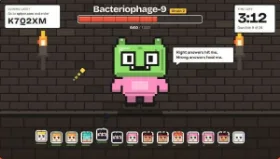
Boss Battle
Unit 2 is full of near misses: the greenhouse effect or the enhanced greenhouse effect, mitigation or adaptation, cap and trade or carbon offsetting. A wrong answer heals the boss, so a class that guesses loses ground.
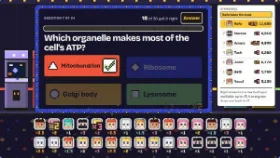
Splycr
Vulnerability and resilience, carbon sink and carbon source, positive and negative feedback: pairs like these are where streaks end. A streak raises the multiplier to 3× and one slip drops it back to 1×, so the student who keeps them straight pulls ahead.